Open Letter: Yes, AI Requires Independent Oversight, But We Have To Design It Right
تم النشر بتاريخ 30 أَيْلُول 2026
To the leaders building artificial intelligence (and the policymakers now responsible for governing it):
For years, those of you building AI have told policymakers and the public, in increasingly concrete terms, that the companies building such consequential technology cannot govern it unilaterally. We agree. And now is the time to act.
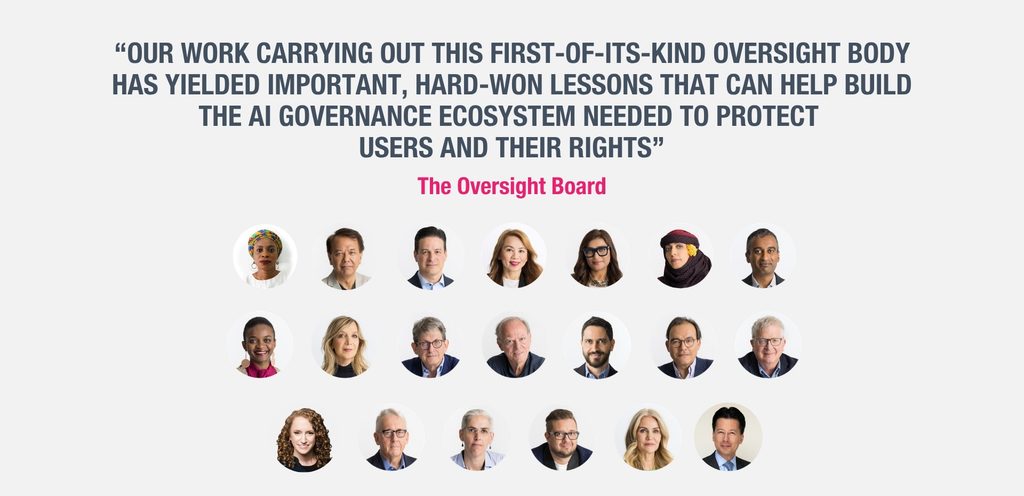
The Oversight Board has worked for the last six years to protect free expression and other human rights on Meta’s platforms. We have published 273 decisions and issued 364 recommendations, addressing far-ranging questions on every continent. Our work carrying out this first-of-its-kind oversight body has yielded important, hard-won lessons that can help build the AI governance ecosystem needed to protect users and their rights. Our experience offers a unique perspective to an industry considering how to erect appropriate and effective safety and governance measures.
Over the last several weeks, we have watched with interest, relief and a fair bit of skepticism as one tech leader after another has sounded the alarm about the perils of AI. They have pledged to implement forms of independent audit or oversight to keep the technologies, and the companies that produce them, from causing a range of potential crises. The scope, powers and operations of such oversight mechanisms remain unspecified. These particulars will determine whether oversight helps to achieve tech titans’ promise of better and safer systems, or offers only a measure of temporary cover as the dangers they warn of grow unabated.
The Oversight Board occupies a distinct role, providing human-rights-based oversight in the form of an external actor that renders decisions independent from business and government interests. The Board is given some access to Meta’s internal systems and policies. Over the last six years, we have developed a way to deliver principled guidance that is situated in operational realities, incorporates public input, and provides a detailed, published rationale that informs the public and can shape future decision-making.
While social media content moderation and AI governance are not the same, there are critical lessons from the former that should be mined for this moment and important parallels that apply to AI companies’ challenges: most notably that a vigilant and principled approach will be required to continuously review and oversee the performance of AI.
Now is the time for all of industry to come together, along with critical stakeholders and policymakers, to build lasting and meaningful governance mechanisms, and bridge the growing trust gap.
While the Oversight Board is not a perfect model to emulate and operates within strict limitations, it is a worthwhile foundation to study and build upon. As participants in this experiment, we are eager to share what has worked, and what has not. Based upon learnings from the Board's strengths as well as its challenges, we suggest the following essential elements of effective independent oversight, acknowledging that independent oversight is just one component of the necessary layers of protection regarding AI’s potential harms:
- Transparency and reasoning: The Board was able to drive changes in a global company with three billion users because it operates in a public way. It published its bylaws and governing documents, announced which cases it was taking and why, and articulated reasoned decisions rooted in human rights standards that could be accessed by reporters, researchers and other companies. We also published and tracked the commitments Meta made to act on our recommendations, opening the company to a level of public scrutiny that resulted in greater accountability. Given that a key motivation for both the Oversight Board and AI oversight bodies is to improve public trust, we believe any oversight body should operate in a public way, shining light on what decisions are made, why and what happens because of them.
- International human rights as the foundation for values alignment, and consistent and fair decision-making: Human rights norms, enshrined in international law, have been used successfully to protect citizens, consumers and platform users, and to hold governments and companies to account. International human rights law and norms are accepted as authoritative by governments and peoples all over the world and should be at the heart of normative guidance on how models behave and the standards they are held to. A commitment to international human rights law allows companies to be accountable to users globally, and to avoid setting standards that are seen as self-serving. Independent oversight based on human rights commitments can operationalize the safety and ethics commitments many companies have already voluntarily made, ensuring they are not empty promises.
- Cross-sector and multistakeholder expertise. Safety and human rights alignment thresholds that govern model releases will need external, independent review by specialists in cybersecurity, national security, child safety, human rights, privacy and numerous other areas, working in coordination. Any oversight body must have a diverse composition and it must not operate in isolation. As the Oversight Board learned through its public comment process, the feedback from varied specialties and organizations is critical to understanding complex issues, and is worthy of emulating in the future.
- Structural stability and independence: Independent oversight bodies need to be separate entities from the companies they oversee. They must have financial independence, controlling their own budget and their structure and composition so that companies cannot force decisions by reducing funding or penalizing them for actions they don’t like. Stringent safeguards must be set up to ensure that oversight bodies’ dependence upon companies for cooperation in their work or continued funding over time do not color decision-making.
- Concrete mandate and authority: Oversight bodies need a clear mandate, and the authority required to fulfill that mandate. In the case of the Oversight Board, it is granted access to information that isn’t publicly available when considering cases or public advisory opinions, and its decisions on the disposition of content in those cases are binding on the company, whether or not they agree. Although the Board’s mandate has been limited in ways that have kept it from addressing serious concerns such as algorithmic amplification, monetization policies and account issues, there is much to be learned from even its limitations. Based on our experience, future oversight mechanisms will need a clearly defined mandate that is ample enough to meet the most urgent needs of industry, the authority to launch its own investigations, and the power to require change.
- Industrywide vs. company specific: Without question, a limitation of the Oversight Board is that only Meta is required to act on our decisions and recommendations. This has made the Board reliant on Meta for its existence and relevance, and has restricted the Board’s ability to drive meaningful change across the industry. At this critical moment, we urge the tech industry to work together toward shared standards, and to create industrywide oversight bodies that protect users and their rights more broadly and more consistently than company specific bodies can accomplish.
The reality is, with a tool that has as much potential and as much risk as AI, we will need a layered approach to governance that includes company policies, industry-adopted standards, independent oversight of those standards from a range of perspectives as well as both regulation and international coordination.
Public trust in AI is declining, as more stories about the actual and potential harms linked to it emerge. Now is the time for all of industry to come together, along with critical stakeholders and policymakers, to build lasting and meaningful governance mechanisms, and bridge the growing trust gap. As leaders of the most powerful companies in the world, we need you to put the same level of leadership energy that you are putting into developing advanced artificial intelligence into developing the trust and safety guardrails that will keep people safe and their human rights respected.
In the days and weeks ahead, we will convene conversations about meaningful and independent oversight. We look forward to engaging industry and policymakers in a dialogue around what has worked, what hasn’t and what we’ve learned over the last six years.
Best regards,
The Oversight Board


