Board Member Spotlight: Katherine Chen
14 de Maio de 2026
In another edition of our ongoing Q&A series featuring insights and experiences from individual Oversight Board Members, we put the spotlight on Katherine Chen, Distinguished Professor of Communication and Vice President for International Cooperation at National Chengchi University (NCCU), Taiwan. She also serves as the Convener for the Science, Technology, and Society (STS) and Communication Discipline at the National Science and Technology Council, Taiwan.
What moved you to join the Oversight Board?
My academic work on platform governance, and earlier service as a commissioner at Taiwan's National Communications Commission, had convinced me that questions about online speech were no longer adequately addressed by either national regulators acting alone or by platforms making decisions in private. The Oversight Board represented something genuinely novel: an independent body empowered to scrutinize the world's largest social media company against international human rights standards. I was also drawn by the prospect of contributing a perspective grounded in East Asia, where the dynamics of authoritarian pressure, linguistic complexity and contested information environments often differ from those that dominate global policy conversations. Joining felt less like accepting an appointment than committing to an experiment in institutional design that I believed deserved to succeed.
How do you think Meta's users have been impacted by the Board's work?
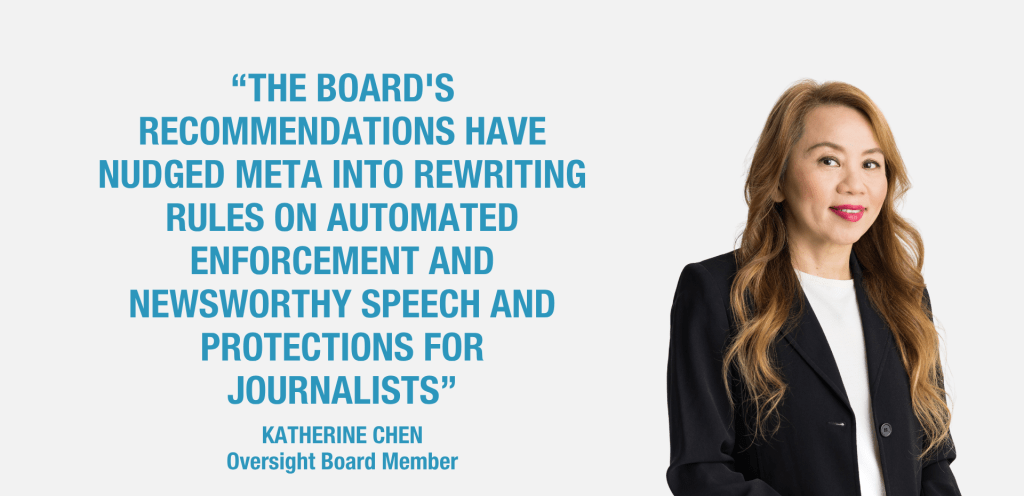
Users now have something they previously lacked: somewhere to appeal that is not simply Meta talking to itself. They also have a growing library of reasoned decisions to wave about when they suspect the company has, once again, got it wrong. Beyond individual cases, the Board's recommendations have nudged Meta into rewriting rules on automated enforcement, newsworthy speech, protections for journalists, and the wild frontier of non-English content, where context tends to go missing in translation. Even users who never appeal benefit from the paper trail. The work is incremental, not miraculous, but the direction of travel is the point.
What is one thing you wish people knew about the Oversight Board?
That the independence is real, not decorative. We deliberate at length, disagree energetically, draft and redraft, and routinely produce conclusions that Meta did not see coming and visibly wishes we had not reached. The process is closer to a serious appellate body than a public relations exercise, and the published decisions, civilized as they are, conceal genuinely heated internal arguments. I also wish people knew the headline cases are merely the visible part. Much of the most consequential work concerns enforcement at scale, where the right answer is genuinely difficult and the wrong one affects a country's worth of users.
What do you think are the most critical issues facing the tech industry?
Three concerns sit at the top of my list. First, generative AI is producing fake images, voices and video at a pace that has outrun every attempt to label them, authenticate them or assign responsibility when they do damage. Second, consent has become a polite fiction. People click “agree” without reading, companies hoover up data anyway, and the box-ticking continues. Third, platforms operate everywhere at once, but the laws governing them are scattered across countries that often disagree with each other. These problems need patient, serious institutional work, not the lurch-from-crisis-to-crisis approach that has dominated tech policy so far.


