Board Member Spotlight: Afia Asantewaa Asare-Kyei
25 de Junho de 2026
Afia Asantewaa Asare-Kyei is a human rights lawyer with extensive experience in strategy development, program design and stakeholder engagement across Africa. She specializes in legal advocacy and social programs focused on human rights, justice and accountability, and the legal empowerment of marginalized groups (women, children, persons with disabilities and LGBTIQI+). Until recently, Afia served as Director for Human Rights, Justice and Accountability at the Open Society Foundations Africa Program where, for 17 years, she led continental initiatives to promote the rule of law and challenge the abuse of power by state, non-state, private sector and foreign actors.
What was it that motivated you to join the Oversight Board?
I have been a human rights and social justice activist for most of my life, laboring in the field of promoting and protecting individual freedom, human dignity, equality, inclusivity and well-being, especially of underrepresented, marginalized and vulnerable communities. I think growing up in South Africa, where from an early age I was confronted with unchecked discrimination, rights abuse, injustice, systemic inequality and indignity led me to this life and career path. I have worked for more than two decades to improve citizens’ access to justice, accountability and democracy. Part of this work has centered on exposing the injustice behind systemic legal and policy failures of both state and private actors, which has required human rights-based assessments and advocacy.
For years, I focused on freedom of expression and access to information issues across the African continent, and I understand ordinary people’s aspirations for credible information. In Africa, Facebook is the internet. People go there to connect, mobilize and build solidarity. In places where the expression of opinions is not a freedom that comes easily, I believe we must fight to protect the few spaces where it exists. Facebook is a formidable platform, and I believed (and still do) that the work of the Board would help to maintain it as a viable and credible source of information. I have a non-negotiable and uncompromising stance on issues, values and principles such as integrity, transparency, accountability, respect for human rights, ethics, and appropriate rules of engagement and conduct, and these were also issues that the Board would be treating. In my work, I have engaged with ordinary people who use Facebook (and even those yet to discover it). I understand their expectations and frustrations. By being on the Board, I believed I could bring this experience, contribute to improving Meta’s content governance and enforcement practices, help to address the concerns and demands of the general public who use the platform, and in so doing, maximize the positive benefits and minimize or mitigate the dangers and negatives.
How do you think that Meta’s users have been impacted by the Board’s work?
The Board gives users an opportunity to appeal Meta’s decisions that they do not agree with, and I think this is very empowering, even if the Board can realistically only take on a fraction of the user appeals. The Board’s work over the past five and a half years has steered Meta to greater transparency, accountability and accessibility. Meta’s policies and rules are now consolidated, and more coherent and accessible to users. Meta is better prepared to respond to crisis situations and prevent harms through the creation of a Crisis Policy Protocol. Coming from a continent that seems to be in a permanent state of volatility, this guidance to both Meta employees and users is enormously valuable. We all want a fairer and more just world, both online and offline, and the Board got Meta to treat its users more fairly and equally by, for example, letting users know when their content has been removed because of government requests. Linguistic accessibility is very important, and users can now read community standards in their own languages. Beyond the individual case decisions on whether a user’s content should be removed or restored, the Board’s real value is its policy recommendations that drive systemic changes at Meta and which uphold freedom of expression and have global human rights impacts that apply to users living in very different circumstances.
What is one thing you wished people knew about the Oversight Board?
I have been in forums or spaces where the question has been raised about whether we are truly independent. I wish people could be flies on the wall inside the Board to witness for themselves just how jealously we guard and protect our independent oversight identity, and how this guides us to make strong and principled decisions; and to see the robust and vigorous nature of our case deliberations, and just how methodical and thorough we are.
Others have asked whether Meta takes our decisions seriously and implements our recommendations. I wish that people would trust that our decisions are indeed binding, and a greater part of our policy recommendations have and are being implemented by Meta. I also wish that people knew about our multistakeholder approach to work – how the Board truly collaborates with and listens to a broad range of actors and voices, which is key to addressing the complex challenges online.
What do you think are the most critical issues facing the tech industry?
There are a lot of concerns over artificial intelligence (AI) systems being developed and deployed by tech companies. Due to the advances in AI, machines are increasingly governing tech platforms. But it is imperative that this evolution is anchored in humanity. This makes oversight rooted in human rights only more important. Ethics and safety are crucial, but these systems must prioritize human rights by design, so that they do not exacerbate existing societal harms and biases. The proliferation of manipulated media, deepfakes and disinformation that makes it difficult for people to distinguish what is authentic and what is fake is also a serious issue. Africa, and indeed the entire Global South, experiences a greater level of instability, and this development in rampant disinformation could be very dangerous and deadly. While technological advancements have improved citizens’ ability to communicate and share information, on the downside, serious issues such as online gender-based violence against women and safety threats for children have increased – female activists, journalists and politicians have been targeted with disinformation and deepfake campaigns, including death and rape threats, and children have been exposed to serious dangers.
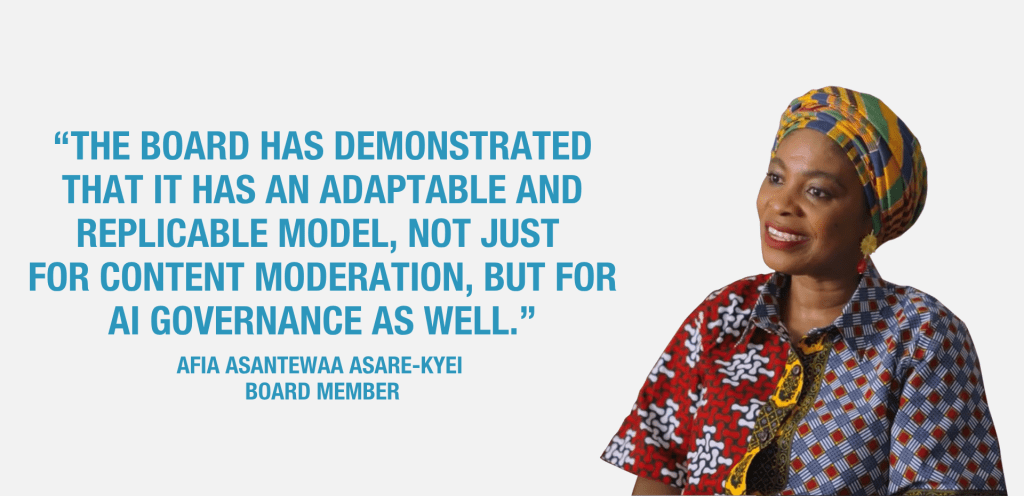
The Board has demonstrated that it has an adaptable and replicable model, not just for content moderation, but for AI governance as well. The Board’s human rights framework is needed even more as technology evolves. Today, there are powerful reminders all around us that human rights are taking a beating from both state and non-state actors. The unraveling of the international human rights ecosystem makes it all the more important for human rights-centered independent oversight and accountability mechanisms such as the Oversight Board to continue to stay engaged.


