On Alleged Atrocities, The Default Must Keep Graphic Awareness-Raising Content On Platform
تم النشر بتاريخ 10 أَيْلُول 2026
Last week, the Oversight Board published its summary decision, Graphic Videos From Iran, which highlights the overenforcement of Meta’s Violent and Graphic Content Community Standard. It is in a context of efforts to document and spread awareness of alleged human rights abuses, impacting the ability of journalists to report on atrocities and of people to identify victims in real time.
The decision refers to two videos showing severely injured and presumably deceased individuals, posted during anti-government protests in Iran late last year and early this year. The users who appealed to the Board over Meta’s takedown of their Instagram videos said, in one instance, that it showed bodies in a morgue to help people find their loved ones killed in the protests. In the second instance, the user said the footage, filmed in a hospital, was meant as "evidence of state-sponsored atrocities" and "records of a massacre." After the Board brought these cases to Meta’s attention, the company reversed its original decisions to remove both videos and restored them.
Enforcement Problem
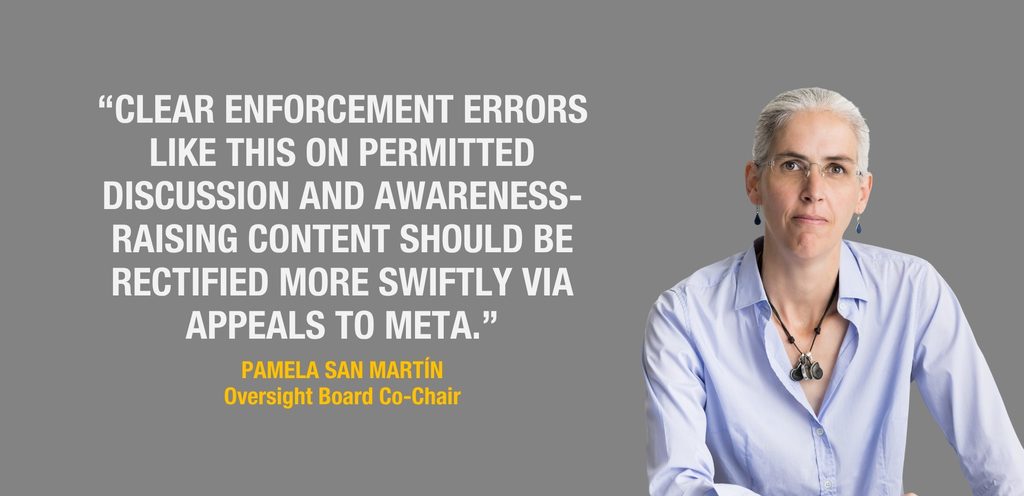
But despite the Board’s intervention leading to the right outcome, the mistake should have been fixed long before that. The policy allows users to share graphic content that sheds light on or condemns “human rights abuses or armed conflict,” however the company continues to remove such posts. The rule is not the problem; rather its enforcement. Clear enforcement errors like this on permitted discussion and awareness-raising content should be rectified more swiftly via appeals to Meta. It should not take the Board identifying them for that to happen.
Such awareness-raising output and documentation is often of most value in the hours after the event.
Such awareness-raising output and documentation is often of most value in the hours after the event, not weeks later once an appeal has been lodged to the Board and processed. A late correction cannot fully undo the harm from a wrongful takedown. By then, the information sharing and documentation functions that Meta intends to permit have already been impaired. Amid violent clashes and conflict, these delays are of particular concern.
This is a design problem the Board has seen before. After our Sudan Graphic Video decision, we recommended Meta change its default to allow graphic awareness-raising content with a warning screen, rather than remove it first and correct later. Meta did not do this. It committed instead to assessing such content "upon escalation" only – case-by-case, not as a standard practice applicable at scale.
AI Moderation Systems
AI moderation systems that Meta is transitioning to may be able to spot awareness-raising content at scale. However, to what extent they achieve protection of human rights (ensuring users can effectively report on and document human rights abuses) will only be determined when there is greater data gathering and assessment, more transparency on those findings, as well as independent oversight on how decisions are made when moving to AI moderation.
Amid violent conflict, these delays are of particular concern.
In addition, these latest cases came to light because users appealed the takedowns. It begs the question: what happens to similar content that is removed but never appealed? In our Armenia Prisoners of War Video decision, from 2023, we recommended to Meta that it develop a protocol for how it preserves content on alleged atrocity crimes and grave human rights violations, which could help in investigations. While Meta reported to the Board on the implementation of these recommendations, the company still has not shared evidence with the Board or the public demonstrating the details of the protocol. It is important for the public to be informed of these measures.
This time, both videos were restored and are now back on platform. However, Meta needs to do more to ensure that it doesn’t take such intervention in individual cases to fix what it should be addressing proactively, at scale.