Online Threats Against Journalists and Public Figures are Evolving. So Must Protections
2 de noviembre de 2026
By Helle Thorning-Schmidt, Oversight Board Member
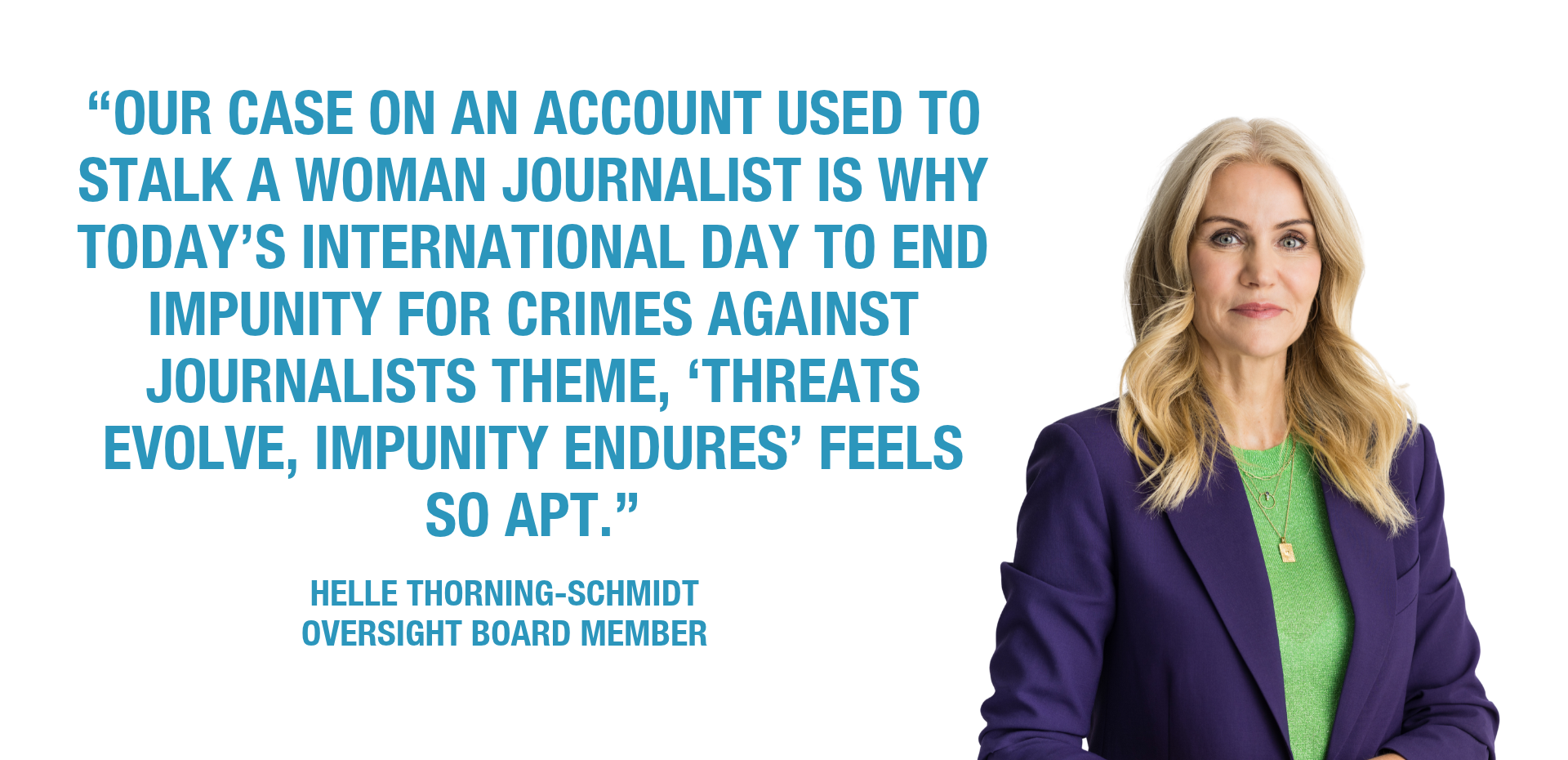
In June, the Board upheld Meta’s permanent ban of an Instagram account that a man had used over a prolonged period to stalk a woman journalist. He posted images of her with a bullseye over her head. He called her a “whore.” Then his followers joined in, sending threats and abuse across multiple platforms. She told us she now lives under security measures that have made her personal and professional life unrecognizable.
Meta only acted to ban the user after the journalist was able to use personal connections at the company to escalate her concerns. Most journalists and other women in public life, especially in global majority countries, do not have that option.
Cheaper, Faster Attacks on Women
Cases like hers are why UNESCO’s theme for today’s International Day to End Impunity for Crimes Against Journalists, “Threats Evolve. Impunity Endures,” feels so apt. AI applications have made attacks on women in public life cheaper, faster and more believable even when fake, from degrading deepfake sexualized images of MPs, cyberbullying of student activists, to fabricated political endorsements. And the harm goes beyond individual journalists, directly impacting the information that the public has a right to receive and creating a chilling effect further limiting expression.
A 2025 UN report found that 70% of women surveyed across journalism, human rights and various fields of public activism had experienced online violence in the course of their work. Over 40% of the surveyed women journalists reported that online abuse had also led to offline harm, including stalking and physical assault, twice the share recorded in 2020. And more than 45% of journalists said they self-censor on social media to avoid abuse.
Less attention has been paid to another deceptive tactic: AI-generated impersonations designed to harass and intimidate women
Much has been rightly said about the severe impacts of synthetic non-consensual intimate imagery as a form of tech-facilitated gender-based violence. Less attention has been paid to another deceptive tactic: AI-generated impersonations designed to harass and intimidate women.
In the AI Video Faking UK Politician’s Immigration Views case, the Board examined an AI-generated video falsely depicting a female Labour Party councilor in Scotland making inflammatory comments about refugees. In that decision, we noted that women politicians, journalists and activists are disproportionately targeted by deepfakes that misrepresent their views. At a roundtable we held on the case, civil society organizations warned about the persuasive effects of realistic deepfakes of politicians and how detrimental they can be to public participation and discourse. This is what we had already warned of in the journalist case, saying, when women are attacked online, “society hears less from women as a result.”
You do not have to be a public figure to be targeted. In the AI-Generated Video of Female Campaigner case, a young Muslim woman gave a TV interview as a campaign volunteer advocating on women's health issues. An online campaign spread across various platforms, manipulating her likeness in cruel and mocking ways to show her doing things she never did: eating large amounts of food, struggling to work out at a gym and depicting her as an animal. As the Board concluded, the aggregate impact of the harassment on this individual “sought to force her retreat from public discourse.” UN Women, the lead United Nations entity on gender equality, has warned that AI tools can be used to generate disinformation and harassment campaigns “automatically and at scale,” often to silence women in public life.
The Choices Platforms Face
Just as AI has intensified online harassment, it can also help curb violence against women. Whether that happens depends on the choices platforms make. The first choice is detection. Frontier AI tools, such as LLMs, are increasingly being used to detect and remove abusive content such as non-consensual intimate imagery. They can also identify coordinated harassment campaigns and recognize patterns of abuse across multiple posts and accounts. But these systems carry risks, including bias in how they make decisions. That is why the Board is researching how LLMs can improve content moderation while protecting freedom of expression and other human rights.
The second is transparency. The Board has repeatedly stressed the importance of watermarking and content provenance standards such as those developed by the Coalition for Content Provenance and Authenticity (C2PA). These give platforms and users reliable signals that content may be AI-generated or manipulated. Consistent implementation of this technology can improve cross-platform efforts to combat deceptive AI-generated content.
It requires platforms to change their policies and processes, and to use these tools responsibly, with meaningful human oversight
The third is reporting. In our AI-Generated Video of Female Campaigner decision, the Board found that existing reporting mechanisms put an excessive burden on victims of harassment. AI-powered assistants could help triage incidents more effectively, identify connected reports and escalate serious threats or repeated harassment. This could reduce the burden on victims trying to navigate complex reporting processes while dealing with ongoing abuse.
None of this requires new technology. It requires platforms to change their policies and processes, and to use these tools responsibly, with meaningful human oversight, transparency and ongoing human rights due diligence. Today is a reminder of just how much work is yet to be done to end impunity for abuse against journalists. AI can make a real difference in combating online abuse against women – both journalists and others contributing to public debate – but only with these safeguards in place. Without them, AI will only deepen the very harms it could help end.
Special thanks to Dumitru Sliusarenco, Maria Rohani, and Max Galler for their contributions to the research and production of this article.


