BOARD MEMBER SPOTLIGHT: RONALDO LEMOS
May 28, 2026
Ronaldo Lemos is the focus of our latest Board Member Spotlight, an ongoing Q&A series featuring insights and experiences from individual Oversight Board Members. Ronaldo is a lawyer specializing in technology, intellectual property, media and public policy. He is a partner at Renno Penteado Sampaio Advogados, a leading law firm in Brazil, and has 20 years’ experience in the private and public sectors.
What was it that moved you to join the Oversight Board?
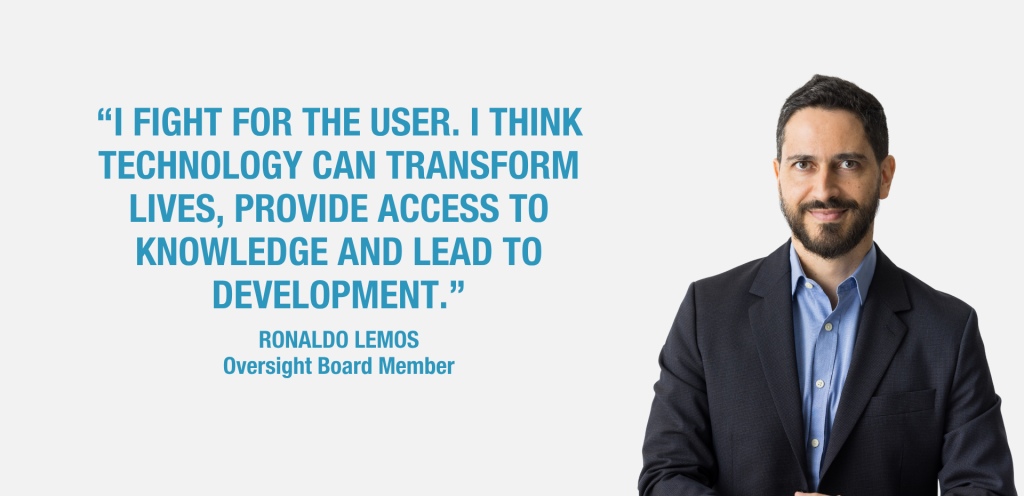
Three things. First, I was born during the military dictatorship in Brazil. As a kid who loved the movies, I was really upset to watch movies in which parts were removed by the censors. And as a young fan of Sylvester Stallone, for example, it was really shocking for me that one of his movies was banned in Brazil. So I got to learn firsthand as a kid what censorship means. Second, I have been deeply invested in protecting the free and open internet. In the 2000s, there were many efforts to control or even censor the internet in Brazil. We resisted that by building a participatory online process used to create Brazil's Internet Law, the Marco Civil. The law was built through a wide online participation process my colleagues and I designed from scratch. Third, I fight for the user. I think technology can transform lives, provide access to knowledge and lead to development. I think these three things led me to the Oversight Board.
How do you think Meta's users have been impacted by the Board's work?
I think users and institutions worldwide have been positively impacted by the work of the Oversight Board. I am a big fan of our “UK Drill Music” decision, in which we recommended that Meta let users know that content removals happened because of a government request. I think our decisions serve as a beacon for the whole industry. In addition, our work also brings national decisions into contrast. For instance, I am not a fan of the decisions that the Brazilian Supreme Court has been making regarding the regulation of online speech in Brazil. I believe many of the Brazilian Supreme Court's decisions would fail the human rights analysis by the Oversight Board.
What is one thing you wish people knew about the Oversight Board?
I wish people looked more closely at our institutional design, which I think is very clever, and could serve as an example for creating oversight over AI, for instance. Our model is replicable, and I think it could be perfectly applied to deal with AI oversight. Also, I think people in general and institutions such as national courts should take notice of the way we work, how we apply human rights law to technology, and the transparency and collegiality that I think are the hallmark of our way of working. I think we can serve as a good practice example for how legal analysis of technology and free speech cases should be done.
What do you think are the most critical issues facing the tech industry?
AI is certainly the challenge now. My wife works with women's health and the other day she asked me if I could build a social network for her audience (she has 7 million visits to her Instagram every month). I took up the challenge, and using AI, I built a social network for her in one week, called “Delas.ai” (www.delas.ai). It is a social network for women, which mixes Reddit and Instagram so that people can share content and discuss health and wellbeing topics. Suddenly, I saw myself wearing Mark Zuckerberg's shoes (on a much smaller scale!). What should I do if this network scales? How, and should, I verify a user is a woman, given the network is designed for them? How should I moderate this thing? How should I order content on people's feeds? So I turned to AI to solve the vast majority of those problems, also keeping in mind all the lessons arising from our OSB work. Using AI is what all social networks will do to solve problems like these. We are living in a moment in time in which a lawyer can build a social network similar to Instagram from scratch in about a week. In this world, the work of the OSB becomes more important. Our decisions so far can really help solve the myriad problems and questions that arise right after the first batch of users joins.


