RightsCon Was Canceled, But There Was Still A Lot To Learn In Lusaka
14 de Maio de 2026
By Nighat Dad
I was already in Zambia’s capital, Lusaka, when the news came through that RightsCon, the leading global summit on human rights in the digital age, was canceled just days before it was due to start on May 5.
At a time when concerns are rising that tech companies’ accountability frameworks are shifting away from human rights toward more subjective concepts, such as values and ethics, and when firms are rarely interviewed or questioned in open forums, these spaces are more than convenings. RightsCon, which is held in a different location annually, is one of the few remaining conferences where the tech leaders building AI governance systems are directly confronted with communities whose rights those systems impact first-hand. It is a chance to participate in the conversation, share concerns and drive accountability. To lose it felt like losing a space that was already too small for everyone who needed to be in it.
Lessen the Divide
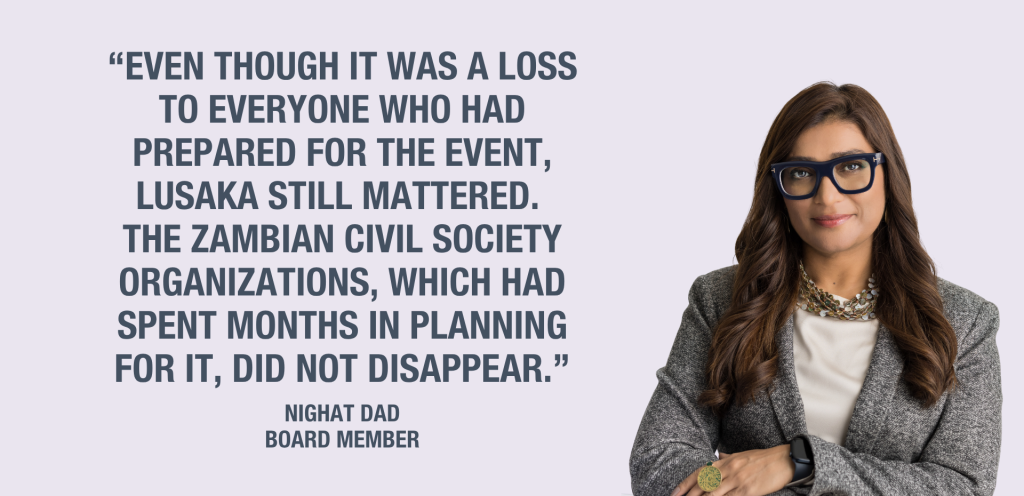
Zambia’s government canceled the conference, saying it did not align with its national values and policy priorities. But even though it was a loss to everyone who had prepared for the event, Lusaka still mattered. The Zambian civil society organizations, which had spent months planning for it, did not disappear. Activists, academics, technologists and rights defenders who had already flown in from across the world were still there. And they had work to do.
My role on the Oversight Board exists precisely to ensure that platform governance reflects the broadest range of human experience. Institutions like ours attempt to widen global stakeholder participation in policy, but they remain, by their very nature, structurally distant from the lived realities of those most affected. All of us working in this space should take every opportunity to lessen that divide.
It is a chance to participate in the conversation, share concerns and drive accountability.
Time and time again, the Board’s casework shows that interpretations of human rights obligations remain abstract at the policy level. But those abstractions have histories and consequences. For many in the Global South, access to such spaces is already constrained. When one is taken away, the imbalance deepens. And Lusaka offered a chance to better understand the context for free expression in Zambia and the wider region, even if it was not the format we had all hoped for.
The irony of World Press Freedom Day being marked in Lusaka on the week the plug was pulled on RightsCon was lost on no one. An event planned by UNESCO (the United Nations Educational, Scientific and Cultural Organization) had originally been intended to run concurrently with RightsCon, maximizing opportunities to participate in both across the week. The UNESCO event proceeded, albeit scaled back from a two-day conference with a planned 1,000 attendees to a one-day event with about half of that number of people. Significant representation came from Zambian and Southern African governments, journalists and civil society.
There, the theme of government intervention continued. A Zambian official from the Ministry of Information and Media, said recent legislation, such as the Cyber Security Act, was a necessary tool to protect citizens from harmful speech and scams, and to safeguard information infrastructure. He asked why this was considered a bad thing. Rather, he argued, concerns about overbroad legislation throttling free speech were overstated and would be worked out in the courts, where interpretation and refinement would take place over time.
Zambian civil society tells a different story. It has been remarked that the cancelation showed people the realities in Zambia. The cancelation cannot be attributed to a single issue, according to some. But there is a growing unease that it may be a precursor to a further silencing of civic spaces in the run-up to general elections in August. Rumours of forthcoming government internet shutdowns are circulating. And they are not unfounded. The last general election in 2021 saw internet access blocked and an onslaught of deadly violence as protestors took to the streets.
This year's cancelation raises difficult questions about who gets to participate in global digital governance, and under what conditions.
For those gathered in Lusaka, this was still a chance for solidarity and learning. Roughly 100 participants who had traveled for the conference reorganized. We met informally, shared research, built connections and stood in solidarity with Zambian rights defenders. In this way, the spirit of the conference persisted, even without the infrastructure.
The cost of the cancelation to African innovation was a key concern, which I heard. African civil society groups and tech entrepreneurs had also stayed on, many with non-refundable tickets and funding conversations they could not afford to miss. One person noted the painful irony: a nation concerned with digital sovereignty and positioning itself as part of a movement towards tech growth in the region was simultaneously closing the door on pan-African innovation.
The moment also fits into a broader pattern of exclusion. When African delegates were denied visas for a RightsCon in Costa Rica in 2023, moving the conference to Africa was a chance to correct that imbalance in representation. This year’s cancelation raises difficult questions about who gets to participate in global digital governance, and under what conditions. For many of us in the Global South, this kind of exclusion is not new, but an uncomfortable truth is that it is far more visible when it impacts people from the Global North too.
And it highlights that government influence on tech governance is expanding from policy to participation. Speculation about geopolitical influence, including from the Chinese government, leading to the cancelation was widespread. But such practices are not unique to Zambia or China. Around the world, access to global forums is increasingly shaped by political considerations. Whether it is restrictions at international assemblies like the United Nations (UN) General Assembly or exclusions from key conversations, power increasingly influences participation. A recent front-page story from the China Daily claimed the U.S. military action in Iran is undermining human rights and the UN Charter. This paper is distributed for free in Zambia with copies piled high in the departures hall of Lusaka airport. While global digital rights groups called out the influence of China on Zambia and the resulting impact on human rights, China was promoting a different narrative in Zambia, that of U.S. culpability for the failure in upholding rights-based conventions. The battle for geopolitical influence is evident across all aspects of information sharing and assembly globally.
What This Means Going Forward
By the end of my week in Lusaka, it became obvious that this canceled conference is a reminder of why these spaces exist in the first place.
In circumstances none of us anticipated, several things became clear:
- Tech companies must continue to engage with the communities that bear the consequences of the decisions they take. This is a key accountability step.
- Engagement across differences matters. We cannot retreat into ideological silos. There must be open spaces for dialogue together.
- Global South voices must be prioritized in policy consultations, including the most marginalized communities. This should be a foundation of governance. We need to build the infrastructure for that engagement to be systematic, so there are avenues that continue when opportunities collapse.
- Civic space requires vigilance. Government interference, in the Global South or elsewhere, is not new. But it must always be challenged.
There are many ways to continue to insist on multistakeholder engagement, and there is room for them all. At the Board, we will continue to amplify the work of civil society, particularly where the experiences of communities can be connected with governance. And we will continue to push for transparency, not just in the companies that are making decisions about speech, but also in how governments influence those outcomes.
I traveled to Lusaka expecting a conference of thousands of attendees. The spaces were smaller than they should have been. But the people in them and the risks they take to be there serve as a reminder to us all why this work matters.