Social Media Bans For Under-16 Users: Good Policy, Wasted Effort, Something In Between?
27 de febrero de 2026
Welcome to POINT/COUNTERPOINT
The Oversight Board is pleased to introduce a new feature: reflections from Board Members on a range of issues facing the technology industry. The views represented here do not reflect the consensus of the full Board, but showcase the diversity of perspectives of our members around the world.
The Oversight Board is committed to upholding human rights online for all users. Our global Board Members represent a diversity of backgrounds, opinions and ideologies but share a commitment to protecting freedom of expression. Major social media companies have determined that children under 13 should not be on their platforms, while at the same time countries around the world consider following Australia’s policy decision to ban young people under age 16 from social media entirely. Three of our Board Members share their perspectives on what’s at stake, including for the 13 to 15-year-olds at the heart of the debate.
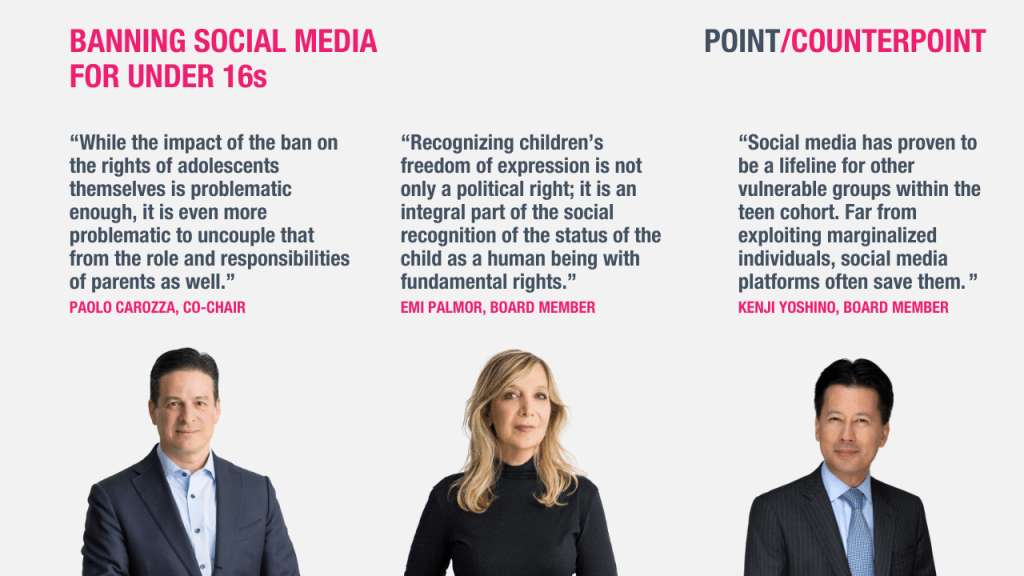
Paolo Carozza, Professor of Law at the University of Notre Dame and Oversight Board Co-Chair
The fact that we are discussing a total ban on social media for under 16s should come as a surprise to no one. Around the world, researchers, lawmakers, whistleblowers and advocacy groups have spent years raising serious concerns about the dangers social media presents to children and adolescents. The recent move by Australia has sparked a healthy shift worldwide from debate to action. Ensuring the safety of young people is obviously an essential part of any program to secure the common good of our communities. However, the policies emerging from these efforts need to be designed with adequate consideration of the full range of rights and interests at stake – those of the children themselves as well as their parents and families.
While international human rights law allows states a lot of discretion in how to serve the “best interests of the child” and doesn’t provide a single answer to complex social questions like this one, broader principles of human rights can help guide our judgment about what makes for good policy.
First, persons under 18 are rights holders. That includes the right to freedom of expression, to receive and access information, to assemble, and to participate in cultural and political life – all in relation to their developing capacities. Those rights need to be taken seriously and should be given due consideration in any sound policy. But we should not stop only at the autonomy and individual rights of children. The “evolving capacities” that are necessary for young people to reach adulthood with the maturity to exercise their freedom responsibly don’t just appear in a vacuum. They are acquired in community, in relationships, and above all in strong and healthy family life. For that reason, human rights law affirms not only the individual rights of children but also that, according to Article 16 of the Universal Declaration of Human Rights, “The family is the natural and fundamental group unit of society.” According to Article 5 of the United Nations Convention on the Rights of the Child (UNCRC), states must respect the rights of parents, members of the extended family, and other persons responsible for the well-being of children. This includes, according to Article 13 of the International Covenant on Economic, Social and Cultural Rights, their right to ensure “the moral education of their children in conformity with their own convictions.”
The isolation of adolescents from communities of support and education and authentic human connection is one of the primary factors that makes them more susceptible to the harms that social media can feed. Good public policy therefore must not impose a one-size-fits-all-families answer to a multidimensional problem, bypassing the essential role of parents and other primary caregivers in determining what is best for their adolescent children. Caregivers certainly need help in safeguarding and educating their children, especially in the face of the frighteningly invasive and manipulative potential of social media and the powerful economic incentives of tech companies to exploit them. Policies to address those harms should focus first on empowering families – giving them the tools, information and education they need to foster young people’s evolving capacities – rather than on blanket bans.
The heavy-handed coercion of the state should always be regarded with suspicion, especially when it claims the authority to displace, rather than to support, those adults who have the primary and direct responsibility to raise and educate children.
So, while the impact of the ban on the rights of adolescents themselves is problematic enough, it is even more problematic to uncouple that from the role and responsibilities of parents as well.
Emi Palmor, Former Director General of the Ministry of Justice, Public Policy Expert and Oversight Board Member
Social media has become an “international language,” a widespread form of communication for billions of users around the world who learned to argue, share information, create communities, and express themselves and their interests. But not all users are the same, and in many societies, social media and children are a combination that arouses fear and substantial and well documented concerns – addiction to screens, harmful content, and above all an encounter between the immaturity of a minor and a social space that at times contains bullying, sexual exploitation, fraud or other harms.
The importance of freedom of expression, access to information or even relief from loneliness is perceived as secondary to potential harms. An exceptional majority of UN member states are parties to the UNCRC. Although adopted in 1989, prior to the emergence of social media, the Convention establishes principles that must guide not only social media platforms, but primarily policies and legislation affecting children.
Blanket prohibitions on access to social media, aiming to protect children from harm, undermine core obligations under the Convention. From a public policy perspective, they reflect a preference for expedient regulation (and some would say quick populist wins) over fulfillment of duties established in the UNCRC that would demand a comprehensive and sometimes expensive governmental investment: ensuring children’s development and capacities means investing in education and social media literacy. There is a lack of investment in relevant school-based education, and the focus is on technical aspects such as limiting screen time or banning phones.
Blanket bans undermine the responsibility and commitment of parents and “extended family” to care for and guide their children; it also ignores the fact that distancing children of illiterate parents or children living in remote areas from an attractive source of information and knowledge will deepen inequality. Recognizing children’s freedom of expression is not only a political right; it is an integral part of the social recognition of the status of the child as a human being with fundamental rights. UNCRC Article 12 establishes the importance and the obligation to give children a voice and participation in proceedings concerning their interests. This has been incorporated into legislation around the world and to reflect the right of children to participate in decisions that impact their lives.
The Oversight Board is committed to children’s human rights within the broader framework of respecting human rights on social media platforms, and it carries out significant work in public participation (giving users “voice”). I believe this issue must be addressed, while ensuring a proper opportunity for both children and parents from diverse communities to participate and exercise the right – and in the parental context, also the duty – to reflect what will ensure the wellbeing of children on social media. This should include an appropriate balance between children’s safety and their right to expression and development, along with a balance between parental rights and duties.
National bans are nothing but regulatory shortcuts that overrun children’s rights and risk undermining parents. They exempt all responsible parties, the platforms and the government itself, from investing time, creativity and budgets to fulfill their obligations.
Kenji Yoshino, Chief Justice Earl Warren Professor of Constitutional Law and Oversight Board Member
Calls to ban social media accounts for teens below the age of 16 are growing. On its face, that catch cry seems reasonable. After all, we already age-gate various domains of social, economic and political life – consider the entirely justifiable age restrictions on the consumption of alcohol and tobacco, child labor and voting. Nevertheless, all three of these analogies end up cutting against, not for, a categorial social media ban.
We place age restrictions on tobacco and alcohol because these substances are physically harmful and addictive, without obvious redeeming features for teens. Of course, the pro-ban argument is that social media is similarly psychologically detrimental and habit-forming at a time when brains are more susceptible to such harms. Yet unlike tobacco and alcohol, social media is not intrinsically addictive. Its addictive features – like infinite scrolling – can be addressed without barring teens from the platform entirely. More importantly, social media has powerfully redeeming features for youth. It is increasingly the public square where teens socialize and engage in civic life.
We place age restrictions on child labor to prevent the exploitation of a vulnerable group. Yet casting “teens” writ large as the only group worthy of protection is again too crude.
Social media has proven to be a lifeline for other vulnerable groups within the teen cohort – just ask the LGBTQ+ teen exploring their identity, the teen isolated in a rural area or the teen living with a disability. Far from exploiting marginalized individuals, social media platforms often save them.
We place age restrictions on voting because we believe minors lack the maturity to make the laws that bind us all. However, we emphatically do not restrict them from political speech, organization, debate or association. We recognize that if we shut down such forms of civic participation – which increasingly occur on social media – teens may not acquire the very skills they need to achieve the political maturity the age restriction reflects. The same argument used to support the ban – that this is a crucial developmental period for human development – here spins in the opposite direction.
In grappling with restrictions on speech, the Oversight Board almost invariably employs the “necessity and proportionality” inquiry drawn from Article 19 of the International Covenant on Civil and Political Rights. While that phrasing sounds fancy, I tell my own teenagers that this boils down to, “Can we cut with a scalpel rather than an axe?” Of course, parents worry about screen time, cyberbullying and mental health – but these concerns can be addressed with targeted strategies, not a blanket ban. We have a whole litany of such strategies, including algorithmic and design changes, time and feature-based restrictions, digital literacy and education programs, privacy and safety protections, and tailored interventions for at-risk teens. Rather than throwing the baby – or teen – out with the bathwater, we can preserve the benefits of having under-16s on social media while minimizing the risks.