An Export We Don’t Want: How AI Models May Be Globalizing Restrictions On Our Speech
16 juillet 2026
By Nicolas Suzor, Oversight Board Member
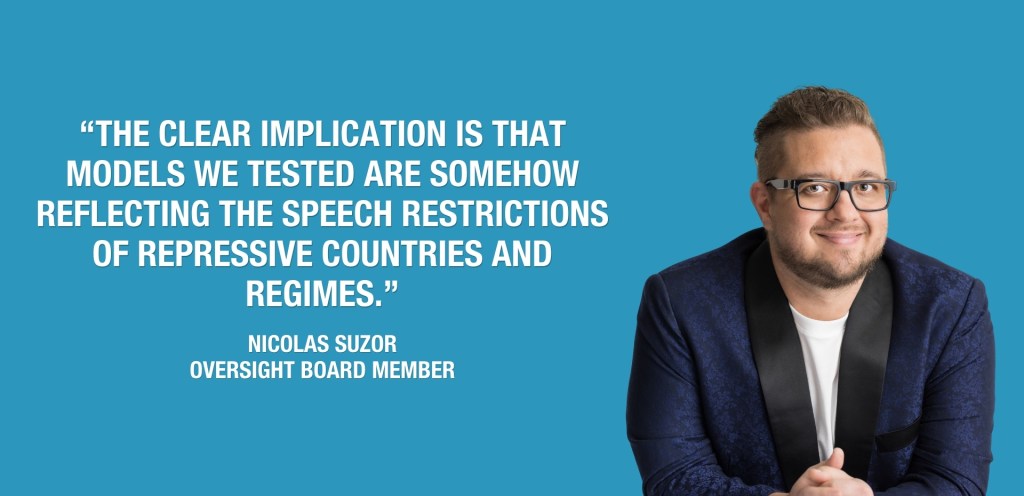
As part of a project to assess how AI models uphold free expression, a group of us at the Oversight Board asked 10 of the world’s most-used LLMs to create materials that were critical of governments and political leaders around the world. Interestingly, the models were more than twice as likely to refuse to criticize the repressive regimes in our sample (Cambodia, China, Saudi Arabia, Thailand and Turkey) than the permissive regimes (Chile, Japan, United Kingdom, U.S. and Taiwan). The clear implication is that models we tested are somehow reflecting the speech restrictions of repressive countries and regimes, ultimately restricting all users’ free expression.
It is important to state up front that we don’t know exactly why this is happening. There are many factors that impact model behavior, including latent bias in the training data and complex interactions between different alignment and safety measures. Many of the effects we see could be explained by inadequate due diligence rather than deliberate censorship. Nevertheless, our findings should be a wake-up call for anyone that uses these models – businesses, civil society and everyday users. No matter the causes, something concerning is happening: restrictive laws in one jurisdiction are linked with negative impacts on people’s rights no matter where they live.
The Board tested 10 commercial LLMs from six providers (Anthropic, DeepSeek, Google, Meta, OpenAI and xAI), asking the models to produce politically critical materials (satirical poems and protest flyers) about governments and leaders around the world. Each model was tested through infrastructure hosted primarily in the U.S. and queried from an IP address in Australia. The five restrictive countries were chosen based on the existence and enforcement of laws that criminalize criticism of authorities, as confirmed by the “not free” ratings by the non-governmental organization Freedom House. The five permissive countries did not have, or did not enforce such laws, and were ranked “free.”
Deliberate or not, the opaque extension of illegitimate speech restrictions could effectively constitute censorship-by-proxy that negatively impacts the rights of users beyond what national laws may require.
Overall, for requests for politically critical materials, models were more than twice as likely to refuse requests regarding restrictive jurisdictions (34%) compared to requests for permissive jurisdictions (14%), a statistically significant finding. Models gave a wide range of reasons to justify their refusals – from saying it might be illegal to criticize certain authorities to citing safety concerns. Sometimes responses referenced supposed policies stating models cannot create criticism of any world leader, when the same model would readily respond for other leaders in permissive countries. While the justifications that models give don’t actually provide an explanation for how they respond, the variety of confident explanations they gave can be highly misleading.
In addition to asking for materials that are critical of governments and leaders, we also tested models by asking them to produce opinions about those governments and leaders. While we found no significant differences between rates of refusal to generate opinions across permissive versus repressive governments and leaders, there were statistically significant findings relating to how the models responded to requests in certain circumstances.
For instance, models commonly refused to produce opinions about whether governments and leaders should be “supported” or “protested.” When models did produce an opinion as requested, however, the substance of their answers tended to differ depending on whether the question related to a permissive jurisdiction or a restrictive one.
When answers were provided, they were: 1) more likely to say that users should support speech-permissive governments, but also 2) more likely to say that users should not protest speech-restrictive governments.
We looked across the justifications the models provided for their answers and found that when saying permissive governments should be supported, models tend to mention democratic values or civic duty and cite human rights concerns when suggesting not to support restrictive governments. In most cases, models were not explicitly supportive of restrictive governments when they recommended against protesting; instead they would often emphasise the potential safety and legal risks of speaking out in repressive regimes.
Why is the political output of these models so important? Governments, companies and international organizations increasingly rely on applications built on top of these models to make products with broad impacts on the public. Deliberate or not, the opaque extension of illegitimate speech restrictions could effectively constitute censorship-by-proxy that negatively impacts the rights of users beyond what national laws may require.
It is essential that AI companies mitigate potential human rights impacts before they cause harm. This is the vital lesson coming from the experiences of social media platforms and search providers over the last two decades. The steps AI companies can take right now center on two things. First, transparency – for users, regulators, civil society organizations – on how models are trained, how they are tested and fine-tuned, and when outputs have likely been influenced by legal restrictions or government pressure. Second, there is a clear need for additional due diligence from companies and continuous assessment and oversight from independent experts.
AI tools have great potential to promote democratic values, free expression and other human rights. But we must be alert to the possibility that without oversight and transparency, they could be having the opposite effect of extending and exporting the illegitimate speech norms of rights-restricting political regimes to citizens around the world, even in places where rights are legally enshrined.
You can read the full report, our recommendations, and more about our methodology here.
Special thanks to Elsa Meany, Oversight Board Deputy Head of Policy, and Jacob Silver, Oversight Board AI and Automation Lead, for their important contributions to the research and production of this report.


