Meta Action on Emoji-Based Racism is Welcome as World Cup Begins
11 juin 2026
By Julie Owono, Oversight Board Member
Today is opening day of the 2026 FIFA World Cup, and as the matches kick off across the U.S., Mexico and Canada throughout the next five weeks, it is a chance to celebrate all of the positive things a global sporting event can do for us – bringing the world together to admire individual prowess and teamwork, engaging in healthy rivalries with friends and family, and taking pride in countries, cultures and national identities.
But as we celebrate the beautiful game, we must not forget there is an uglier side to the World Cup and other major sporting events: racist abuse and hate speech on social media that targets athletes, supporters and other users. The people who post vile messages know what they are doing is wrong and against the rules, so they try to dodge the algorithms by using coded language, or “algospeak,” which includes using emojis in hateful ways.
On February 10, 2026, the Oversight Board called on Meta to improve its automated and human review processes to comprehensively account for “algospeak” when used to express hateful messages, in two cases involving content that used monkey emojis to compare them to Black people.
In one of the cases, a user in Brazil posted a short video on Facebook featuring a scene from the movie, The Hangover, in which two characters, dubbed in Portuguese, are claiming ownership of a monkey. Text overlaying the video names the characters as the Spanish football clubs “Barcelona” and “Real Madrid.” Additional overlay text refers to boys rising to prominence in Brazilian football.
The Brazilian post was made in the context of widely documented systemic racism and hostility in football, particularly targeting Black players. For example, Vinicius Junior, a Real Madrid player, has experienced multiple racist incidents, including comparisons to monkeys. The racism has escalated to a point where the Brazilian state of Rio de Janeiro passed the “Vinicius Junior Law” in 2023 to combat racism during sporting events.
But as we celebrate the beautiful game, we must not forget there is an uglier side to the World Cup and other major sporting events.
In Europe, several other high-profile incidents against Black football players in stadiums and on social media have been widely reported in Spain, Italy, France and England. Players are taking a zero tolerance approach to racist abuse the moment it happens on the field. Vinicius Junior, supported by Real Madrid teammate Kylian Mbappe, refused to play in protest during a Champions League match, and AC Milan players walked off the field to protest racist chants against the team’s goalkeeper.
Still, studies have documented sustained waves of abuse following matches. A study by the trade union for professional footballers in England and Wales, the Professional Footballers’ Association, and data science company Signify, found that in 2020 more than 3,000 of the tweets sent to some players were explicitly abusive and 56% of these were racist, and 29% of the racially abusive posts used emojis. A 2025 report by the Union of European Football Associations (UEFA) found that 33% of posts flagged to Meta, TikTok and X for abusive content share around UEFA club finals were classified as racist.
The Board made three recommendations to Meta in the decision:
- Audit and update training data: The Board recommended Meta audit the training data used for the automated systems that enforce the company’s policy on hateful conduct. We said Meta should also ensure the data is updated periodically to include examples of content with emojis in all languages, uses of emojis that violate the policy and new instances of emojis being used in a hateful way.
- Harmonize efforts to disrupt hate campaigns: We said Meta should bring together existing efforts to proactively disrupt hate campaigns that are covered under the Hateful Conduct, and Bullying and Harassment policies, including, for example, direct attacks on people that include dehumanizing comparisons with animals, and protections against mass harassment of individuals. More coordination of these policies would better protect people who are not directly named but who are the implicit targets of hateful campaigns, such as top athletes and other users of Meta’s platforms.
- Actively monitor content during major sporting events: We recommended that Meta’s existing time-sensitive prevention and enforcement efforts include active monitoring of content with emojis that incites discrimination immediately before, during and after major sporting events such as the FIFA World Cup or the Olympics.
Meta is required to publicly respond to Board recommendations within 60 days, and we are encouraged to see that the company says it is implementing in full two of the three recommendations – auditing and updating training data and actively monitoring emoji-based hateful content during major sporting events.
Regarding the training data, Meta says the data used to train algorithms to detect Hateful Conduct violations includes emojis across languages, including examples of the hateful use of emojis. The company says it updates training data on a daily basis to ensure it is “current and comprehensive.” During events such as the World Cup, the company says it will use targeted measures to reduce user exposure to violating content, including content with emojis. Meta has also committed to share insights on classifier training data in a future confidential update to the Board.
The company is also implementing in full our recommendation to actively monitor the platform for hateful content around high-profile sporting events. In its response, Meta says it regularly supports time-sensitive efforts to reduce and mitigate harm during major sporting events like the World Cup. These measures include dedicated working groups to identify and safeguard the authentic accounts of athletes, federations and key participants.
As for our recommendation to harmonize existing efforts to disrupt mass harassment campaigns, Meta says this is work the company already does, through enforcement actions under the Bullying and Harassment, and Hateful Conduct community standards. In our view, the lack of coordination between these policies leaves an enforcement gap for individuals targeted by hate campaigns, but who might not be explicitly named in the posts. In these cases, Meta defaults to hate speech rules, but we think these are insufficient on their own, which is why we made the recommendation to harmonize the two policies. Meta’s solutions fall short of what the Board intended with the recommendation.
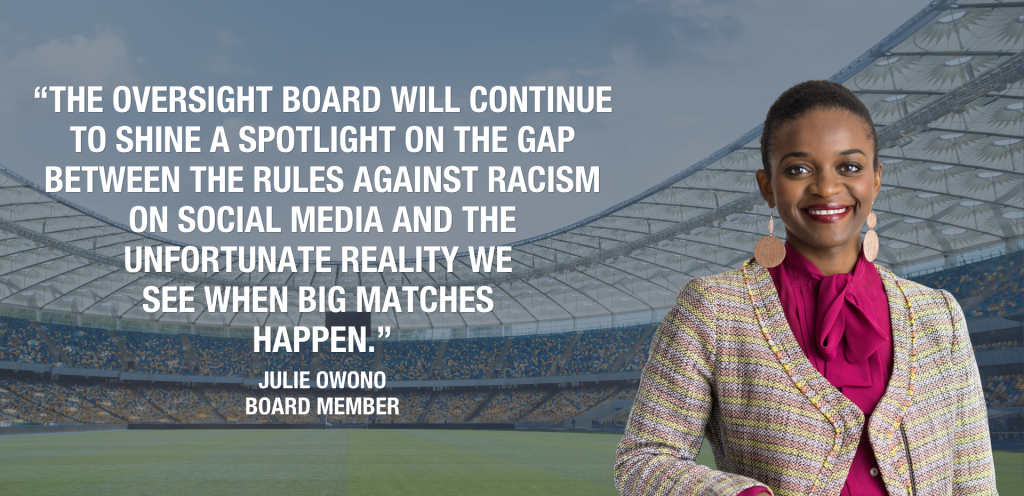
In implementing two of the three recommendations in the decision, Meta’s actions are welcome and necessary steps to combat online racism in the context of sporting events. The Oversight Board will continue to shine a spotlight on the gap between the rules against racism on social media and the unfortunate reality we see when big matches happen, because there is much more for us all to do to confront this harmful and growing problem.